More results...

  • Cart
  • Checkout

Claire Givens Violins, Inc

Dealers, Makers & Restorers of Fine Violins, Violas, Cellos & Bows

  • Instrument Collection
        • VIOLINS

          • Up to $1,000
          • $1,001 – $2,000
          • $2,001 – $4,000
          • $4,001 – $8,000
          • $8,001 – $12,000
          • $12,001 – $20,000
          • $20,001 – $40,000
          • $40,001 – $60,000
          • $60,001 – $100,000
          • Over $100,001
          • Popular Student Violins
          • Small Violins
        • VIOLAS

          • Up to $1,000
          • $1,001 – $2,000
          • $2,001 – $4,000
          • $4,001 – $8,000
          • $8,001 – $12,000
          • $12,001 – $20,000
          • $20,001 – $40,000
          • $40,001 – $60,000
          • $60,001 – $100,000
          • Over $100,001
          • Popular Student Violas
          • Small Violas
        • CELLOS

          • Up to $2,000
          • $2,001 – $3,500
          • $3,501 – $5,000
          • $5,001 – $8,000
          • $8,001 – $12,000
          • $12,001 – $25,000
          • $25,001 – $50,000
          • $50,001 – $100,000
          • Over $100,001
          • Popular Student Violas
          • Small Violas
  • Bow Collection
        • Violin Bows

          • Up to $300
          • $301 – $600
          • $601 – $1,000
          • $1,001 – $1,500
          • $1,501 – $2,500
          • $2,501 – $5,000
          • $10,001 – $20,000
          • Over $20,001
          • Small Violin Bows
        • Viola Bows

          • Up to $300
          • $301 – $600
          • $601 – $1000
          • $1,001 – $1,500
          • $1,501 – $2,500
          • $2,501 – $5,000
          • $5,001 – $10,000
          • $10,001 – $20,000
          • Over $20,001
          • Small Viola Bows
        • Cello Bows

          • Up to $300
          • $301 – $600
          • $601 – $1,000
          • $1,001 – $1,500
          • $1,501 – $2,500
          • $2,501 – $5,000
          • $5,001 – $10,000
          • $10,001 – $20,000
          • Over $20,001
          • Small Cello Bows
  • Workshop
        • Under the long-time expertise and leadership of Workshop Manager Douglas Lay, the Givens Violins Workshop is staffed by a team of professionally trained violin makers and a full-time Bow Specialist. Our mission is to assist players in obtaining the best sound and response from their instruments and their bows. We encourage you to call us at 612 – 375 -0708 or e-mail us at workshop@givensviolins.com to discuss any questions you may have and to make an appointment. The workshop provides estimates of work needed and maintains a weekly schedule, upholding a reputation for careful, thorough, and high-quality restorations.
        • About The Team

          Meet Doug Lay, Workshop Manager

          Meet Kim Spagnola, Bow Restorer

        • WorkShop

          About the Workshop

          Instrument & Bow Checkups

  • Dipper Early Instruments & Bows
        • DIPPER EARLY INSTRUMENTS & BOWS

          Early Violins

          Early Violas

          Early Cellos 

        • DIPPER RESTORATIONS WEBSITE

          Dipper Restorations Website

        • MEET THE DIPPER STAFF

          Meet The Dipper Staff

        • BAROQUE BOWS

          Baroque Violin Bows

          Baroque Viola Bows

          Baroque Cello Bows

        • CLASSICAL BOWS

          Classical Viola Bows

          Baroque Cello Bows 

          Baroque Cello Bows 

        • POPULAR DIPPER RESTORATIONS BLOGS

          Andrew Dipper Early Bow Models

          Andrew Dipper Early Instrument Restorations

          Getting Started in Early Music

          Historical Instruments & Bows

          Historical Maker Profiles

          “Dear Mr. Puppy” Column

  • Products
        • We carry a wide variety of accessories including strings, mutes, shoulder rests, chin rests, metronomes, music stands, and more. Our string prices are the lowest on the market. Accessories are easily shipped upon request. To make a purchase, please contact us today (link) or stop by our shop, 10am – 5pm, Tuesday - Saturday.
        • Cases

          Books

          Featured Accessories

  • Services
        • As a full-service string shop, Givens Violins offers a wide range of services to our clients through every step of the instrument selection process and throughout your playing career.
        • Trial-Program
          Trade-In Policy
          Financing
          Teacher Gift Card Program

        • Appraisals & Consignment
          Shipping
          Warranty
          Return Policy

  • About Us
    • Meet The Staff
    • Testimonials
    • Community Support
  • Resources
        • Resources

          Instrument Insurance

          Industry Links 

          The Anatomy of a Violin

          The Anatomy of a Bow

          String Instrument Maintenance Guide

          La Voce Newsletter Archives (1997-2009)

        • GIVENS VIOLINS BLOG 

          Advice for New Players, Parents and Students

          Instrument Care & Keeping

          Spotlights on Important Current & Historical Makers

          Interviews with Staff & Professional Musicians

          Humor & History

  • Contact us

More results...

November 2, 2017 by Givens Violins

String Theory: Historical Facts About Your Violin Strings
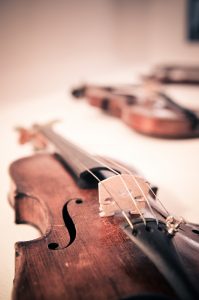
Violin stringsAs musicians, we are constantly in search for information regarding the music we play and our instruments. Many of us are aware that violin strings were once made out of gut, but perhaps you didn’t realize that gut was the standard material used until after World War II. Evidence found in ancient Egyptian hieroglyphics suggest that the production of strings made of sheep gut spans back some 6,000 years. It would require an entire book to divulge every detail of string history, but here are several key points on the history of violin strings.

The G String

  1. As with other strings, the G string began as a pure gut string. By the late 1600s, G strings were wound with silver or copper wire to produce a fuller, resonating sound.
  2. The sound of wound G strings was clearly superior to that of pure gut, and by the 1730s pure gut had been totally replaced by wound gut.

The D String

  1. Pure gut D strings were the standard until end of the First World War. In times past the technology needed to produce wire thin enough to wind the string simply didn’t exist.
  2. In 18th Century France, a method called demi-filée (half-wound) was developed, which applied the wire to the core of the string. This solution resulted in very thick D strings and never became widespread, vanishing completely by the end of that century.
  3. The use of aluminum to fully wind gut D strings can be traced to the period after WWII.

The A String

  1. The A string was the last of the four strings to transition from pure to wound gut. Pirastro developed the first wound gut A string in 1951 using aluminum. It took nearly ten years before it became standard.
  2. The pure gut A string was common until the advent of synthetic strings in 1970.

The E String

  1. Due to their thin gauge, gut E strings were never wound, and pure gut E strings were common well into the twentieth century. The first steel E string appeared around 1910, but didn’t gain prominence until the Second World War when sheep gut became scarce.
  2. From the 1880s until the development of steel strings, silk strings were used as an alternative to gut, but usually only in the case of an emergency.

Strings as most of us know them today are made from synthetic materials and then wound in aluminum, chrome, steel, silver, or an alternative metal. Wound steel strings were long-lasting and not as sensitive to the climate as gut, however most players found them to have an undesirable metallic or ‘tinny’ quality. Synthetics present the best of both worlds: the warm timbre of gut combined with the reliability of steel. The first synthetics were developed by Thomastick-Infeld and released into the market in 1970, popularly known as Dominant.

Filed Under: Humor & History Tagged With: aluminum violin strings, gut strings, gut strings history, history of violin strings, silk violin strings, steel violin strings, synthetic violin strings, synthetic violin strings history, violin strings, violin strings history, when did violin strings become wound with metal, wound metal violin strings, wound violin strings

Resources

  • Insurance
  • Industry Links
  • String Instrument Maintenance Guide
  • The Anatomy of the Violin – Learn about the different parts of the violin
  • Anatomy of a Bow – The Ultimate Guide to Violin Bows
  • BACK TO SCHOOL: Preparing for Back-to-School Music Lessons and Orchestra
  • The New Season begins – A Checklist for Professionals
  • Blog
  • FAQs
  • La Voce Newsletters
  • Sitemap
  • Renting Vs. Buying Your First Violin, Viola, or Cello
  • Contact us
  • About Us

Contact

1201 Marquette Ave. Suite 150
Minneapolis, Minnesota 55403
Directions

Phone: 612-375-0708 or
800-279-4323
Fax: 612-375-0096
cgivens@givensviolins.com

Contact Us

Connect With Givens

Sign up for our Newsletter

Select list(s) to subscribe to

Hours

Tuesday – Saturday
10:00 a.m. – 5:00 p.m.

612/375-0708 

Parking

Parking is available at: The Plaza Ramp and the Hilton Hotel Ramp (11th Underground Ramp). Click here for details.

Quick Links

Job Opportunities

Our Mission

Site Map

FAQS


Translate Our Site

Sphinx Partnership

Givens Violins is a proud Partner of the Sphinx Organization!- Transforming lives through diversifying the arts.

Our Affiliations

Accessibility Statement

Review us on : Google

Claire Givens Violins Inc. © 2026
Developed by EMOD, LLC
  • Home
  • Directions
  • Parking
  • Blog
  • oldContact Us
  • Workshop
  • Services
    • Trial Program
    • Trade-In Policy
    • Appraisals
    • Consignment
    • Instrument & Bow Checkups
    • Accessories
    • Teacher Gift Program
    • Financing
    • Shipping
    • Warranty
    • Return Policy
  • About Us
    • Workshop
    • Meet The Staff
    • Testimonials
    • Community Support
    • Our Mission
    • Job Opportunities
  • Resources
    • Insurance
    • Industry Links
    • String Instrument Maintenance Guide
    • The Anatomy of the Violin – Learn about the different parts of the violin
    • Anatomy of a Bow – The Ultimate Guide to Violin Bows
    • Blog
    • FAQs
    • La Voce Newsletters
    • Sitemap
  • Inventory
    • Violins
    • Violas
    • Cellos
    • Violin Bows
    • Viola Bows
    • Cello Bows
    • Small Instruments
    • Small Bows
    • Early Instruments & Bows
    • Books
    • Cases
  • Dipper Restorations
    • Inventory
      • Early Instruments & Bows
        • Early Instruments
          • Violins
          • Violas
          • Cellos
        • Early Bows
          • Violin Bows
          • Viola Bows
          • Cello Bows
          • Bass bows
    • Dipper Restoration Staff
    • Projects
    • Links
    • Popular Dipper Restoration Blogs
      • Mr Puppy blog
      • Restoration Blog
      • Bow Model Blogs
  • Cart
    • Checkout

×

Please inquire about pricing

Thank you for your inquiry. We will contact you shortly.